Baby chicks on a flower farm have a way of resetting everything.
It starts before you even open the lid. A soft, layered chorus, not chirping exactly, more like small urgent questions being asked all at once. You carry the box in from wherever it came to rest, set it on a surface, and stand still for a moment. The sound finds you. And for a few seconds, all the other noise of the season falls away.
This week, 12 one-day-old chicks arrived at Dynomite Farm, shipped from Cackle Hatchery.
We don’t take chicken selection lightly. Raising baby chicks on a flower farm means thinking about temperament as much as egg production, about how each bird will integrate into the rhythms of a working organic homestead. This year’s flock brings four heritage breeds, each with a distinct personality and purpose.
Black Australorps. Three pullets, glossy as polished obsidian, with a quiet steadiness that makes them the anchors of any mixed flock. Australorps are one of the great utility breeds, prolific layers, calm handlers, and genuinely curious foragers. On a flower farm, a calm chicken is a gift.
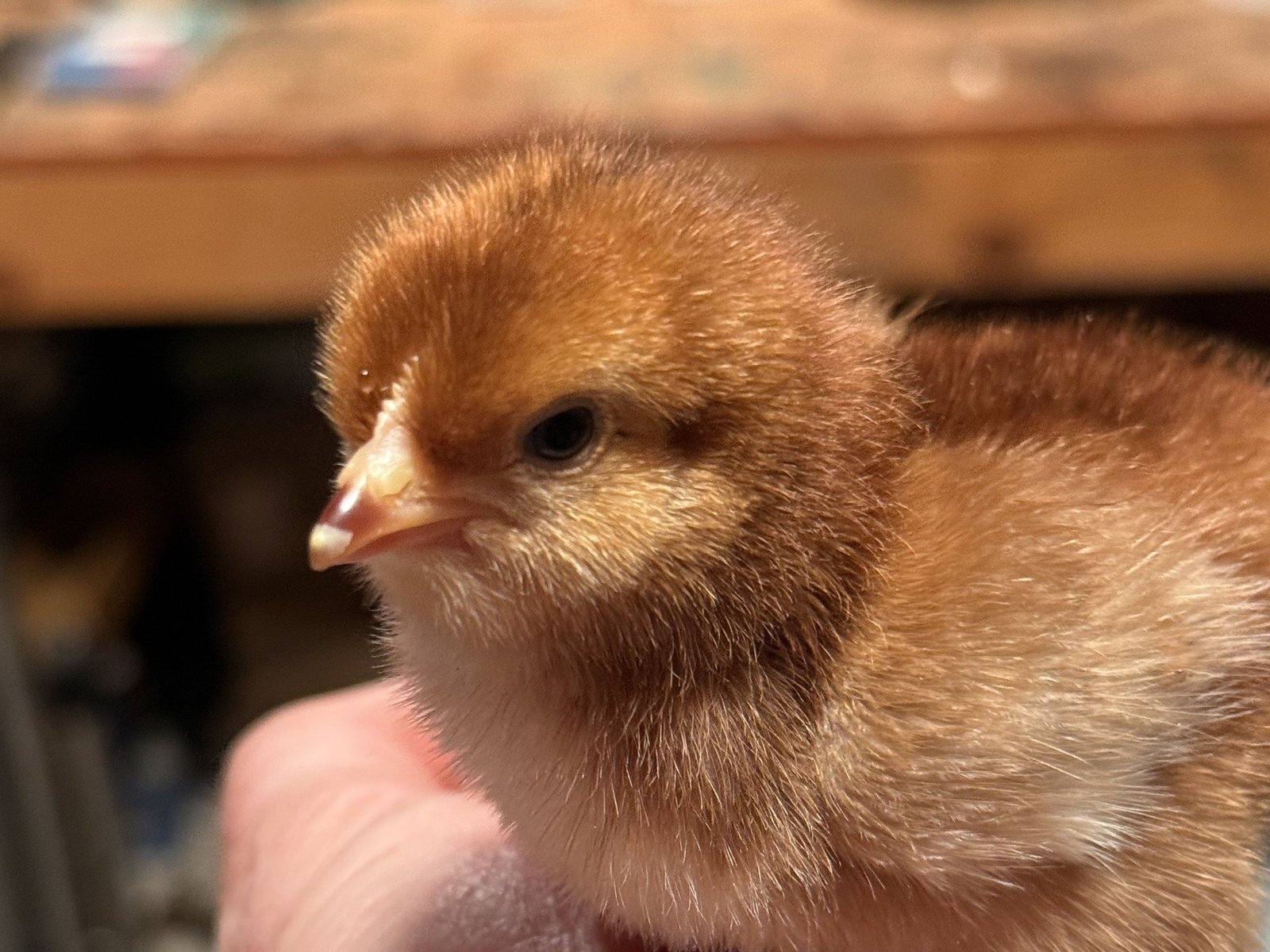
Rhode Island Reds. Three more pullets, the classic American homestead bird for good reason. Hardy, adaptable, and reliably productive through the cooler months when the dahlias are long past. RIRs bring a warm, earthy contrast to the flock, both literally and figuratively.
Speckled Sussex. Three pullets with a gentle disposition and some of the most beautiful adult plumage in the poultry world. As they mature, each feather develops a white tip, giving them a confetti quality that feels right at home against a backdrop of dahlias and late-season blooms. Sussex are exceptional foragers and grow calmer with handling, making them ideal for a farm that hosts visitors.
Olive Eggers. Three pullets, the crossbred wild card of the group. Olive Eggers carry the genetics for producing olive-green eggs, a detail that delights guests on farm visits and photographs beautifully in the context of a flower-forward homestead. They tend toward independent personalities and a certain quiet intelligence.
Twelve birds total. Three of each. A small but intentional flock.
The care sheet arrived with the chicks. The instructions are specific: warm water, 90 to 105 degrees for the first 24 hours. Dip each beak, one at a time, so they know where the water is. Watch for lethargy. Keep the brooder at 100 to 105 degrees at floor level, with a cool-down zone on the opposite side. Temperature drops five degrees each week after that.
There is a meditative quality to the first hours of raising baby chicks on a flower farm. You move slowly. You check the thermometer again and again. You watch for the signs: warm chicks spread out and explore; cold chicks huddle and go quiet. These twelve spread out almost immediately.
By mid-afternoon, they were investigating every corner of the brooder, pecking at the pine shavings, pushing against each other in the small competitive way that chicks do around the waterer. One of the Speckled Sussex fell asleep standing up, beak almost touching the feeder.
This is a question worth answering honestly, because it isn’t obvious from the outside.
Dynomite Farm is not a poultry operation. It is, first and foremost, a small organic flower farm and working homestead in the coastal hills of Santa Cruz, California. The flowers, dahlias, ranunculus, seasonal cuts, are the heartbeat of what we do. So why keep baby chicks on a flower farm at all?
The short answer is that chickens and flowers are not separate systems. They are parts of the same one.
A healthy flower farm runs on soil. Rich, biologically alive, microbe-dense soil that holds moisture, drains cleanly, cycles nutrients, and supports the root systems of heavy-blooming dahlias and the delicate corms of ranunculus. That kind of soil doesn’t come from a bag. It comes from years of intentional organic matter layering, from compost, from the slow work of living systems doing what living systems do.
Chickens are composters. They scratch, they turn, they deposit nitrogen-rich manure into the organic cycle in a form that breaks down quickly and integrates beautifully with wood shavings and vegetable matter. A chicken flock working in rotation around a farm produces one of the most effective soil amendments available, without a label, without a purchase order, without anything but time and observation. If you want to start your own cycle at home, Santa Cruz County’s composting resources are a great place to begin.
They are also insect managers. In the beds between seasons, when the dahlias are dormant and the soil is bare, chickens do a kind of low-level pest patrol that chemicals can’t replicate. They scratch up pupating insects before they become problems. They disrupt the soil surface in ways that actually improve aeration. They eat the things that would otherwise wait in the dark for your next planting season.
And then there’s the less quantifiable thing: chickens give a farm its pulse. They create noise and movement and a reason to walk the beds every morning. Farming is observational work, and anything that keeps you moving through the space, pausing, noticing, adjusting, tends to make you better at it.
Regenerative flower farming is a philosophy as much as a practice. It asks you to think not in single seasons but in cycles. What does this bed need in January to support a September dahlia? What happens in the soil between the last frost and the first tuber? Who is doing the work you can’t see?
Chickens answer some of those questions.
But they are one part of a larger web. At Dynomite Farm, compost is built year-round from farm waste, kitchen scraps, and chicken bedding. That compost feeds the raised beds. The raised beds grow the flowers. The flowers feed the pollinators. The pollinators improve fruit and seed production in the homestead gardens. The gardens produce kitchen scraps. The scraps return to the compost.
Chickens are not peripheral to this loop. They are woven through it. Keeping baby chicks on a flower farm isn’t a novelty, it’s an investment in the soil that grows everything else, including the dahlias our guests come to cut each summer.
This is what it means to run a living homestead alongside a working flower farm. Not two separate operations sharing real estate, but one integrated system that gets richer and more resilient every season.
It is late May in Santa Cruz, and the farm is in that narrow, pressured window between ranunculus season and dahlia season, the seam in the year where the pace doesn’t slow so much as shift.
The ranunculus corms have come up. The beds are being prepped for dahlia tubers going in now through early June. The greenhouse holds the starts that will become this summer’s cutting garden. The soil is warm. The mornings are still cool enough to work in comfortably, but by afternoon the light has that quality that means summer is very close.
There is a particular feeling to raising baby chicks on a flower farm at exactly this moment in the year, when everything is leaning toward bloom and a box of small new lives arrives to lean right along with it.
They are in the brooder now, small and loud and thoroughly alive. In six weeks, they will be feathered out. In five months, they will be laying. Next spring, they will be on rotation through the beds.
But for now, they are just chicks. And that is more than enough.
We will be sharing photos and video from the entire chick arrival, the unboxing, the brooder setup, the first hours, over on our Instagram feed. If you have ever wondered what raising baby chicks on a flower farm actually looks like day to day, or you simply want something warm and alive in your feed this week, come find us there.
There are a lot of photos. And at least one video of a Speckled Sussex falling asleep at the feeder.
If the idea of baby chicks on a flower farm speaks to you, and the slow, seasonal homestead life that surrounds them, there are a few ways to go deeper.
You can visit Dynomite Farm through one of our U-Cut flower experiences, available seasonally. You can become a member and become part of this place in a more ongoing way. Or you can read more on the farm journal and follow along as the flock grows and the dahlia season unfolds.
This is a small farm. One party at a time. Every visit is an appointment. That’s intentional, it’s how we keep the experience what it is.
We would love to have you.
Why do flower farms keep chickens?
Chickens contribute to the regenerative cycle that makes a flower farm soil-healthy over time. They produce nitrogen-rich manure for compost, scratch and aerate soil between seasons, and manage insect populations naturally. On a homestead farm, baby chicks on a flower farm are part of the ecosystem rather than a separate operation.
What chicken breeds are best for a homestead?
Heritage breeds like Black Australorps, Rhode Island Reds, and Speckled Sussex are excellent homestead choices because they are hardy, calm, productive layers, and good foragers. Olive Eggers are a popular crossbreed for their distinctive green eggs and independent temperament.
How does chicken manure help flower gardens?
Chicken manure is high in nitrogen, phosphorus, and potassium. Composted properly with carbon-rich materials like pine shavings and garden waste, it becomes one of the most effective organic soil amendments for supporting blooming perennials and annuals like dahlias and ranunculus.
Can you visit Dynomite Farm to see the chickens?
Dynomite Farm operates by appointment only, one party at a time, in Santa Cruz, California. Visit dynomitefarm.com to book a U-Cut flower experience or farm visit during the dahlia and ranunculus seasons.
What is an Olive Egger chicken?
An Olive Egger is a hybrid breed produced by crossing a blue-egg-laying breed (such as an Ameraucana) with a dark-brown-egg-laying breed (such as a Marans). The result is a chicken that lays eggs in shades of olive green, which are visually striking and popular on farm-to-table homesteads.