If you have ever wondered why flower farms keep chickens, you have probably been given the same answer everyone gives: compost, fertility, a beautiful closed-loop system where the birds feed the soil that feeds the flowers.
We are going to be honest with you. That is not why we keep ours.
At Dynomite Farm we buy our compost in bulk, twelve cubic yards at a time, delivered and ready to feed nineteen raised beds of dahlias and ranunculus. A handful of chickens scratching around the homestead does not come close to that, and we are not going to pretend otherwise. So the real question of why flower farms keep chickens has a different answer here, and it comes in three honest parts.
Let’s start with the least romantic and most true reason of all. We keep chickens because we love fresh eggs.
There is a real difference between an egg from a hen that spends its days scratching in the sun and one that has traveled a week to reach a grocery shelf. The yolks are deeper, almost orange. They stand up tall in the pan. For a household that already lives by the seasons, gathering eggs in the morning is one of the quiet pleasures that makes this life feel whole.
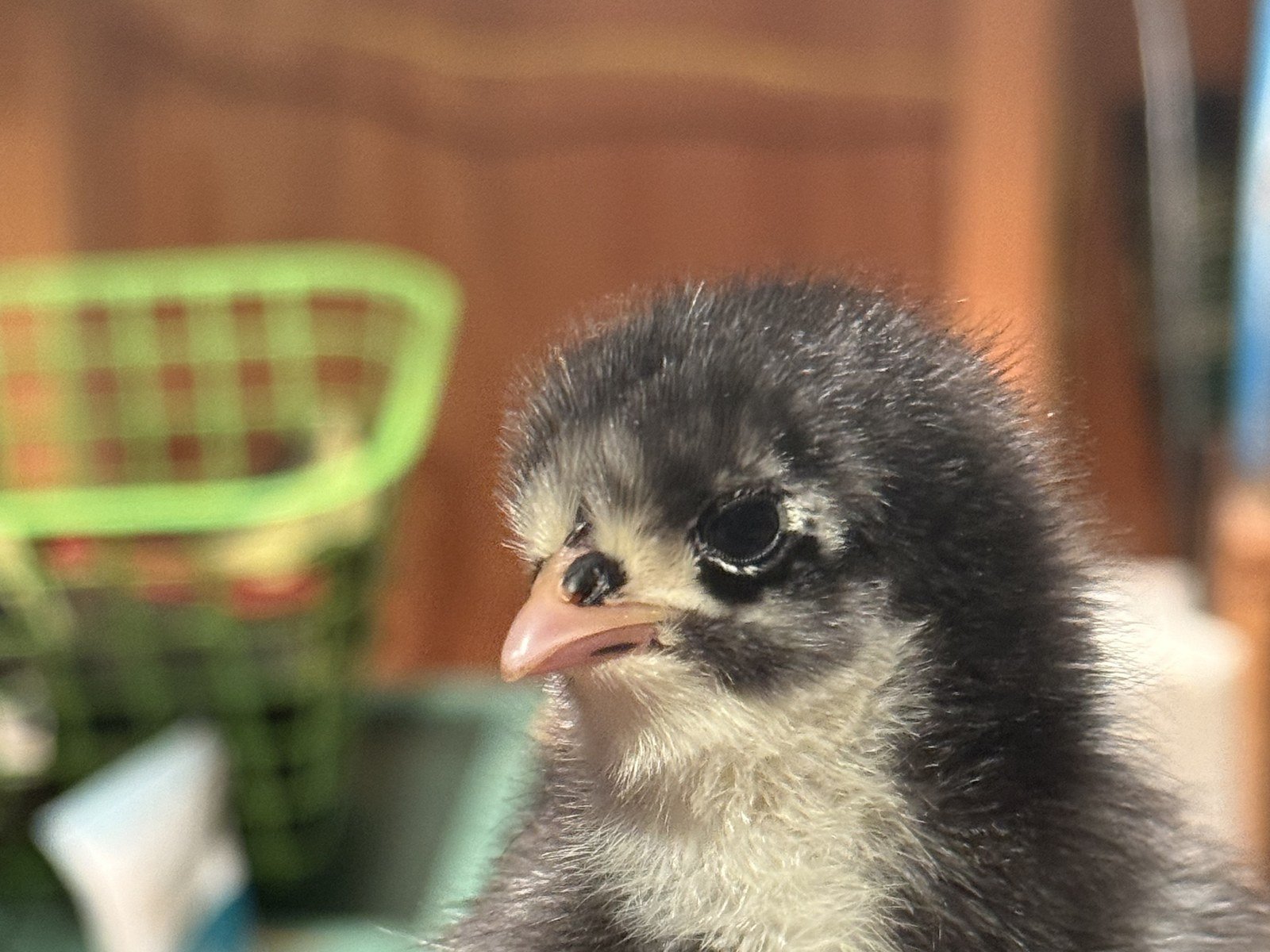
Our four heritage breeds were chosen partly for exactly this. Black Australorps and Rhode Island Reds are among the most reliable layers you can keep. Speckled Sussex lay a steady, warm-toned egg. And our Olive Eggers will, in time, give us those soft green eggs that look almost too pretty to crack. When people ask why flower farms keep chickens, the simplest answer is often the most overlooked one: breakfast.
This is the reason that actually matters to our business, and it is the one most farms undersell.
When a guest comes to Dynomite Farm for a U-Cut flower experience, they are not only buying flowers. They are buying an hour inside a living place. And a living place has more than blooms in it. It has the sound of a hen muttering to herself in the corner of the garden, a flash of feathers crossing a path, the small delight of a child meeting a chicken for the first time while a parent fills a bucket with dahlias.
That is not a side note. It is the difference between buying a bouquet and remembering an afternoon. The wider world of experiential agriculture has understood this for years. According to NC State Extension’s research on agritourism, hands-on farm experiences and time spent with farm animals give visitors a fuller, more memorable connection to a place than crops alone. At farms built around animal encounters, the animals are frequently the single biggest draw, even when there is plenty else to do.
So a large part of why flower farms keep chickens, at least for us, is dimensionality. The chickens turn a transaction into an experience. They make the farm feel like a farm.
Now, having told you the chickens are not our fertility engine, we will give the soil people their due. Part of why flower farms keep chickens, yes, is the genuine if modest help the birds give the land.
They patrol the beds between seasons and eat the insects that would otherwise overwinter in bare soil. They scratch and aerate the surface as they hunt. Their bedding, when we clean the brooder and coop, goes into the compost pile and becomes a real, if small, part of the cycle. None of this replaces twelve yards of bulk compost. All of it is genuinely useful, and we would be silly to waste it.
The honest framing is this: the chickens are a wonderful supplement to a soil program, not the program itself. Any flower farm that tells you a backyard flock fertilizes a commercial cutting garden is selling you a feeling, not a fact. We would rather give you the feeling and the fact.
There is a popular fantasy, and it is a lovely one, of the perfectly self-contained farm where nothing comes in and nothing goes out. The chickens fertilize the flowers, the flowers feed the bees, the kitchen scraps feed the chickens, and the whole thing spins quietly forever.
The reality of running a small, productive flower farm in Santa Cruz is more honest and, we think, more interesting. We bring in bulk compost because our beds demand more than a closed loop can give. We keep chickens because we love eggs and because they make this place better to visit. Both things are true at once, and neither one needs to pretend to be the other.
That is the most useful answer to why flower farms keep chickens. Not because the birds are a fertility machine, but because a farm is meant to be lived on, walked through, and enjoyed, and chickens make all of that richer.
Understanding why flower farms keep chickens actually changes what a visit feels like. When you come to cut flowers with us, expect company. The flock is part of the farm now, and a growing part of the experience. You will likely hear them before you see them.
If you would like to be here for it, you can book a U-Cut flower experience during the season, or become a member and make the farm a regular part of your year. And if you want to watch this particular flock grow up, we are documenting the whole thing, starting with the day the baby chicks arrived.
Come for the dahlias. Stay for the hens.
Why do flower farms keep chickens?
Flower farms keep chickens for several reasons: fresh eggs, natural insect and weed control between seasons, a modest contribution to compost, and, increasingly, to enrich the visitor experience. At Dynomite Farm the honest priorities are eggs and experience, since we source the bulk of our soil fertility from compost bought by the truckload rather than from the flock.
Do chickens really fertilize a flower farm?
Chickens contribute nitrogen-rich manure and bedding to a compost pile, but a small flock cannot supply the fertility a commercial cutting garden needs. Most working flower farms supplement heavily with bulk compost. Chickens are best understood as a helpful supplement to a soil program, not a replacement for one.
What chicken breeds are good for a flower farm?
Calm, productive heritage breeds work well around visitors. Black Australorps, Rhode Island Reds, and Speckled Sussex are hardy, reliable layers with gentle temperaments, and Olive Eggers add colorful green eggs that delight guests.
Can I see the chickens when I visit Dynomite Farm?
Yes. The flock is part of the farm experience. Dynomite Farm operates by appointment, one party at a time, in Santa Cruz, California. This is a short term event as the chicks get big quickly!